
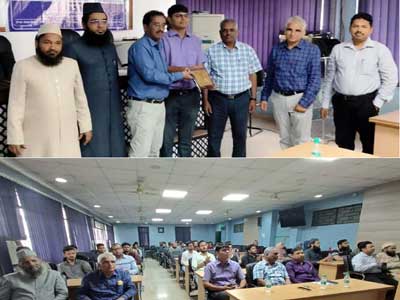
Aligarh: The challenges involved in civil engineering structures and reducing the disaster risks owing to various natural as well as man-made hazards were discussed in a one-day national workshop, organized by the Department of Civil Engineering, ZH College of Engineering & Technology, Aligarh Muslim University.
Prof. Abdul Baqi, Chairperson of the Department of Civil Engineering, welcomed the guests, resource persons, and participants. Prof. Amjad Masood, Coordinator of the programme introduced the theme of the workshop, entitled “Disaster Risk Reduction and Challenges in Civil Engineering Structures”.
Prof. Abhishek Kumar from IIT Guwahati highlighted various natural as well as man-made hazards and emphasized the importance of disaster mitigation.
“Microzonation maps can serve as a basis for evaluating site-specific risk analysis, which is essential for critical structures like nuclear power plants, subways, bridges, elevated highways, sky trains, and dam sites”, Prof Abhishek said.
He elaborated that Seismic microzonation can be considered the preliminary phase of earthquake risk mitigation studies.
Er. Subodh K Gupta, Director (Projects), MMRC, Mumbai said that underground structures are strategic elements in transportation and utility networks, like tunnels used in metropolitan cities for mass rapid transit systems, water conductor systems of hydro-power projects, roadway and railway tunnels in hilly areas, large underground gas and petroleum storages, nuclear waste repositories, etc.
“Metro underground tunnels should be designed in such a way that vibrations due to moving trains as well as due to earthquakes do not cause any significant effect on the passengers traveling, the tunnel liners, other important equipment in tunnels, on the ground surface, and also on the above ground structures”, he said.
Prof. Masroor Alam highlighted the issue of climate change evidence and geoengineering. He emphasized that as climate change continues, it will likely lead to more frequent and severe natural hazards.
“The impact will be heavy. Climate change causes poverty and food shortages and forces even higher numbers of men, women, and children to flee their homes. Changes in the global climate exacerbate climate hazards and amplify the risk of extreme weather disasters”, said the AMU faculty member.
Earlier, in his opening remark, Prof. Abdul Baqi highlighted the achievements of the Department. He said that disaster management is the need of the hour and the Department will be at the forefront to provide solutions and consultancy in the area of earthquake resistance design and testing of the structures.
Dr. Rizwan A Khan, the Organizing Secretary of the workshop proposed the vote of thanks.
Dr.Md Rehan Sadique and Dr. Ajmal Husain were the other organizing secretaries for the workshop. Mr. Himank Sharma and Ms. Tavishi Sharma, students in their second year M.Tech were the student coordinators of the workshop.
Related Items
Workshop held on ‘Advances in Deep Learning’
Workshop on Fruit Preservation organised
Workshop held on ‘Managing Menopause’