
New Delhi / Alwar: “The problem of marine litter is a serious transboundary issue – eight million tonnes of plastic waste, from 192 countries that have a coastline, go into our oceans every year. India, with a 7,000-plus km coastline, has a role to play in controlling this menace,” said Sunita Narain, director general of the Centre for Science and Environment, in her keynote address at a two-day national consultation workshop.
A National Coalition of Coastal Cities, which will focus on combatting the scourge of marine litter across the country, was launched at the workshop, which was organised and spearheaded by CSE.
Global research estimates that about 80 per cent of marine litter comes from land-based mismanagement of solid waste that reaches the ocean bed through various land-to-sea pathways. The remaining 20 per cent is the contribution of coastal settlements. About 90 per cent of all the waste that ends up in the marine ecosystem is plastics.
Out of 460 million tonnes of global plastic production, close to 353 MT comes back as plastic waste – 8 MT of which is leaked into the marine ecosystem, as Narain pointed out.
CSE researchers point out that in India, the estimated extent of marine litter is about 0.98 metric tonnes of trash per km stretch of the coastline, with a concentration of 0.012 kg per square metre. Says Siddharth G Singh, programme manager, solid waste management unit, CSE: “Tributaries of major Indian rivers are the pathways that carry around 15-20 per cent of plastic waste into the marine environment.”
India’s 7,517 km of coastline across nine states and 66 coastal districts, is home to about 250 million people. The coastline has 486 census towns and 36 class I towns. It also hosts 12 major and 185 minor ports. India is the world’s second-largest fish-producing nation, with about 2,50,000 fishing boats, 40,00,000 fisherfolk and 3,600 fishing villages. India’s coastline also has a rich biodiversity, protected by about 4,120 km of mangroves.
One of the key challenges worldwide is Abandoned, Lost or Discarded Fishing Gear. A large part of ALDFG is lost in deep seas, making it difficult to recover. India has 174,000 units of fishing gear in operation, of which 154,008 units are gillnets/driftnets, 7,285 units are traps, and the rest are fishing lines. According to the Food and Agriculture Organization, India loses 15,276 tonnes of gillnets annually.
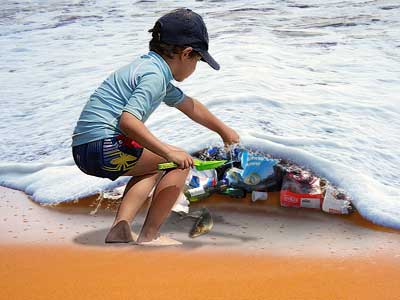
One of the most common sources of marine litter is tourist and beach litter. A majority of these wastes are made up of multi-layered and low-value plastics, polystyrene, plastic products like cutlery and carry bags, cigarette butts, etc. These wastes are either not collected or are mismanaged, and eventually leak into the oceans through the stormwater drainage system, canals and small and big rivers. A large amount of footwear waste comprising of soles, synthetic bases and cloth bases is also being found in marine litter in India.
The other contributors to marine litter include fishing communities, flood waters, discharge of untreated municipal sewage, automobile and industrial waste generated at the coasts and waste from shipbreaking yards.
The workshop was attended by representatives from state and city administrations from coastal states, marine research institutes, multi-lateral institutes working in India and other countries, NGOs working in the domain of marine litter, industry and technology solution providers, academicians, start-ups and individual practitioners and experts.
Related Items
Workshop held on ‘Advances in Deep Learning’
Workshop on Fruit Preservation organised
Celebrating the Spirit of Science on National Science Day