
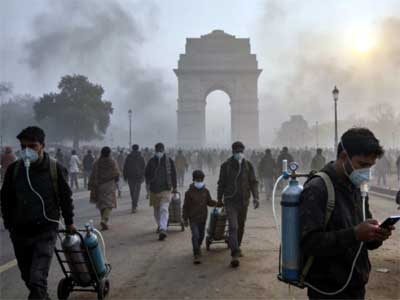
Early one winter morning, a worker coughed longer than usual. The air was cold, the fog thick, and every breath burned his lungs. He could not tell whether it was a seasonal allergy or something far more sinister. What he did know was that missing work was not an option. Polluted air might slowly choke his body, but hunger would strike faster.
Across North India, this scene has ceased to be exceptional. It is now routine. Breathing itself has become hazardous, turning a basic biological act into a daily gamble. This is no longer a quirk of weather or a temporary seasonal crisis; it is a deep, chronic public health emergency that the country has failed to confront.
Read in Hindi: ज़हरीली सांसों का समाजवाद : जब हवा अमीर–ग़रीब में करने लगे फर्क...
As winter tightens its grip, toxic smog once again blankets Indian cities. In Delhi, the Air Quality Index routinely hovers around 400, squarely in the ‘very poor’ to ‘severe’ category. PM2.5 levels remain several times higher than safe limits. Agra, home to the Taj Mahal, is not far behind, with AQI readings touching 300 and particulate matter directly attacking lungs and hearts. Cities such as Lucknow and Gorakhpur are trapped in the same suffocating spiral.
What was once considered a ‘North India problem’ has now spread nationwide. Mumbai has recorded AQI levels around 180, Pune around 212, and Hyderabad close to 166. Data from IQAir, AQI.in and the Central Pollution Control Board expose an uncomfortable truth: despite years of monitoring, public campaigns and substantial funding, the air Indians breathe has not meaningfully improved.
A recent national roundtable organised by Janaagraha, “Air Pollution in Cities: Challenges and the Way Forward”, put its finger on the real wound. More than 35 experts from government, academia, philanthropy and civil society converged on one conclusion: while data has multiplied, governance has not.
Janaagraha’s year-long assessment of the National Clean Air Programme, supported by the 15th Finance Commission, reveals a sobering gap between intent and outcome. While a handful of large cities have partially utilised funds, a staggering 85.5 per cent of cities are lagging behind their PM10 reduction targets for 2024–25. Independent analysis by CREA further shows that only 20–30 per cent of NCAP cities have achieved sustained reductions in pollution, even as the national target has now been raised to a 40 per cent cut by 2026.
This is not merely a story of insufficient money or weak political will. India’s air-monitoring network has expanded rapidly, yet pollution remains a regional and multi-sectoral crisis. Transport emissions, construction dust, waste burning, industrial activity and agricultural practices beyond city boundaries all contribute, but accountability is fragmented. Urban local bodies are tasked with delivering results, yet they are denied adequate authority, technical expertise and timely funding.
The roundtable also highlighted a critical disconnect: abundant data that fails to translate into real-world action. Compliance looks neat on paper, but the air outside tells a different story. Dr Suresh Jain of IIT Tirupati warned that pollution respects no administrative boundaries and demands a framework of shared responsibility. Janaagraha’s Chief Policy and Insights Officer, Anand Iyer, stressed that clean air is achievable only if city governments are empowered, as they are closest to citizens. Janaagraha CEO Srikanth Viswanathan urged Chief Ministers to elevate clean air from a seasonal concern to a permanent governance priority, backed by long-term collaboration with civil society.
The human cost of this failure is brutally unequal. The poor, informal workers and those who labour outdoors inhale the worst air, live shorter lives, and carry the heaviest health burden. This is environmental inequality in its rawest form, a silent class divide measured in lung capacity and life expectancy. During the winter of 2025, cities such as Delhi, Agra and Lucknow repeatedly crossed hazardous AQI thresholds. Schools shut down, mobility suffered, and daily life stalled. Smaller cities and less urbanised regions face similar risks, but weak monitoring and institutional invisibility keep them out of the spotlight.
The path forward is clear, even if politically uncomfortable. India must move beyond counting sensors and tracking expenditure, and instead demand measurable outcomes. Responsibilities must be sharply defined at the city, district and state levels. Sector-wise emission indicators must guide action. Cities need robust planning tools, impact assessments and technical support. Most importantly, funding must be transparent enough for citizens to see not just where money was spent, but what actually changed.
The winter of 2025 should be treated as a final warning. Delhi is now ranked among the world’s most polluted capitals. Agra’s historic skyline fades behind a curtain of smog. Tens of millions of Indians are being forced to inhale poison every single day. Incremental steps and symbolic gestures will no longer suffice.
Clean air is not a luxury, nor a seasonal favour. It is a fundamental public right. To delay decisive action is to condemn future generations to a crisis that remains preventable even now. The time has come to move from merely measuring pollution to enforcing accountability, or this democracy will continue to run on poisoned breath.
Related Items
Meet the ‘Radio Man of India’, Record holder Radio Collector!
Webinar on Gender-Inclusive Leadership for Developed India
Conference on Legacy of Central Asia and India organized