
This article is dedicated to the glorious, searching history of socialism and to sage-like figures such as Satchidananda Sinha, who never treated politics as a game of power, but as a lifelong pursuit of truth.
Socialism was not born from the brilliance of a single mind. It emerged from humanity’s collective rebellion against the cruelty unleashed by the Industrial Revolution. In the 18th and 19th centuries, as Europe’s factories turned human beings into expendable cogs, early dreamers like Robert Owen and Charles Fourier imagined cooperative communities rooted in dignity and equality. Later, Karl Marx and Friedrich Engels gave socialism its intellectual spine, arguing that history itself was a record of class struggle and that emancipation would ultimately come through the working class.
In the twentieth century, socialism fractured, evolved, and adapted. Lenin turned it into a revolution in Russia. Rosa Luxemburg warned Europe that socialism without democracy would decay into tyranny. In India, socialism took an even more distinctive path. Thinkers such as Acharya Narendra Dev, Jayaprakash Narayan, and Dr Ram Manohar Lohia wove Marxist ideas with Gandhian ethics and the lived realities of India’s villages. It was never merely about seizing power; it was about transforming society from below. It was within this quiet, ethical, and questioning tradition that Satchidananda Sinha belonged.
On November 19, 2025, in the small village of Manika in Bihar’s Muzaffarpur district, the long and thoughtful journey of Sachchidanand Sinha came to a gentle close. He was 97. There were no breaking-news tickers, no television debates, no social media storms. Yet with his passing, an honest, austere, and self-critical chapter of Indian socialism quietly ended.
Some lives do not create a stir even in death. Sachchida ji was one such person. He remained distant from spectacle all his life. He had no craving for podiums, no hunger for positions, no urge to be counted among the powerful. He belonged to that rare tribe of socialists who practised their beliefs not through slogans or speeches, but through the way they lived. Our former editor, Trevor Drieberg, often described him as a socialist influenced by Trotsky’s ideas. Sachchida ji would speak with fascination about the Trotskyists from Sri Lanka who participated in the Quit India Movement of 1942. For him, history was never a museum of dates; it was lived memory.
Trotsky’s idea of ‘Permanent Revolution’, which rejected Stalin’s theory of ‘Socialism in One Country’, appealed to him because it insisted that socialism could not survive in isolation while exploitation thrived elsewhere. This internationalist moral urgency stayed with Sachchida ji all his life.
Nearly two dozen books and countless articles formed his true inheritance. Many of his writings were syndicated by the National Press Agency, where I worked as an Assistant Editor. Then came the Emergency. Independent thinking was handcuffed. Dissent went underground.
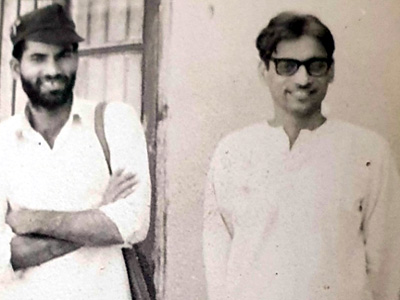
During those years, Sachchida ji lived in a modest barsati in Lodi Colony. We lived in the barsati of the adjoining Block 18. Paras Nath Chaudhary (in photo) lived nearby, as did Verma ji from Bihar. Daily meetings were inevitable. Sometimes Prof Dev Dutt, who published the weekly ‘Point of View’, would join us. Long hours were spent either at the Coffee House in Connaught Place or on the lawn of the UNI canteen.
Our conversations ranged freely, from politics, society, art, farming, and philosophy. Nothing was forbidden. His life was disarmingly simple: bread or khichdi, nothing more. One never felt that he occupied unnecessary space on this earth.
Arguments were often sharp. We found his positions idealistic, sometimes impractical. He held firm, uncompromising views. We teased him affectionately, calling him a ‘Marxist Gandhian’. Yet disagreement never turned into bitterness. He guided us with the quiet authority of a family elder.
Many of his English manuscripts were typed by my wife, Padmini, who worked at a public relations firm in Jorbagh. His handwriting was delicate yet precise, much like his thinking. He moved effortlessly from political economy to European art, from rural sociology to spiritual inquiry. He could speak for hours about farming practices, village rhythms, birds, leaves, and flowers. To sit with him was to be reminded that intellect does not need arrogance to shine.
Born in 1928 into a well-to-do family, Sachchida ji grew up breathing the air of freedom. Comfort never tempted him. He abandoned formal education midway, believing that life could not be understood solely through classrooms. Instead, he chose experience.
He worked as a labourer, became a coolie at a railway station, descended into mines, and toiled in mills. This was not romantic posturing. It was a sincere attempt to align life with belief.
Though he lived in Delhi for years, his heart remained anchored in the village. Eventually, he returned to Manika, spending his final years amid mango trees, open skies, and the slow, healing pace of rural life. He had no institutional affiliations, no academic titles, no political patrons. Reading, reflection, and conversation defined his world.
He held no degrees, yet his scholarship was formidable. Fluent in Hindi, English, French, and German, he read Marx, Gandhi, Lohia, and Rosa Luxemburg deeply, without becoming a disciple of any. Questioning was his faith. Doubt was his discipline.
Books such as The Internal Colony, The Bitter Harvest, Chaotic Creation, and Emergency in Perspective remain powerful commentaries on Indian society, politics, art, and authoritarianism.
The Internal Colony stands out as a seminal work. In it, Sachchida ji argued that post-independence India reproduced colonial patterns internally. Cities, he said, became new colonisers, extracting labour and resources from villages while concentrating development within urban enclaves. Mineral-rich states like Bihar yielded iron and coal, yet their people remained poor. Without decentralisation and genuine village empowerment, he believed, socialism would remain hollow rhetoric.
No one left disappointed after meeting Sachchidanand Sinha. He compelled people to think, but he also left them with hope. He never married, disliked praise, and detested self-promotion.
In an age where noise substitutes thought, and speed replaces depth, his absence feels sharper. He reminds us that true greatness lies not in loud voices or public acclaim, but in a life lived honestly, simply, and reflectively.
His farewell was silent. His legacy, however, continues to speak, softly, persistently, and far beyond the confines of time.
Related Items
Symposium on Sage Agasthya held in AMU
Study of coins as a tool for understanding history discussed
Miss Universe Great Britain meets elephants in Mathura