
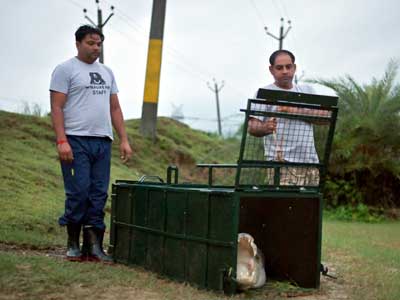
In a remarkable rescue operation, a massive 10-foot-long crocodile that had ventured out of a water canal and into the agricultural fields of Kabirpur Bagwala village in Etah was successfully rescued and returned to its natural habitat.
The incident unfolded when panicked villagers spotted the crocodile and immediately alerted the nearest forest department.
The enormous reptile was spotted by villagers wandering into an agricultural field, causing alarm among residents. Recognizing the potential danger and the need for intervention, the villagers promptly reported the sighting to the nearby forest department, who wasted no time and contacted Wildlife SOS for their expert assistance.
Upon receiving the call, the forest department contacted Wildlife SOS on its emergency helpline. A dedicated four-member team from Wildlife SOS quickly arrived at the scene and, after an hour-long operation, successfully rescued the giant crocodile.
The recent heavy rains in western Uttar Pradesh have caused water bodies to overflow, prompting crocodiles to venture out. This situation highlights the need for swift action to ensure the safety of both wild animals and local communities.
Kartick Satyanarayan, Co-founder and CEO of Wildlife SOS stated, “This incident underscores the delicate balance between human habitation and natural spaces. Our team is committed to safely relocating wild animals that wander into populated areas, particularly during challenging weather conditions.”
Baiju Raj MV, Director of Conservation Projects at Wildlife SOS, added, “We are grateful for the quick response from the local villagers and the forest department. This collaboration is vital for successfully rescuing animals in distress, especially in urban areas.”
Aditya Saxena, Range Forest Officer of Etah, expressed his gratitude, stating, “I would like to thank Wildlife SOS for their expertise and swift response during the rescue and release operation. Their assistance is invaluable in protecting wildlife and ensuring public safety.”
Following a thorough on-site medical examination, the crocodile was safely released back into a suitable habitat, where it can thrive without further disturbances.
The Mugger crocodile, also called the Marsh crocodile, is native to the Indian subcontinent, Sri Lanka, Myanmar, Pakistan, and some parts of Iran. It is most commonly found in freshwater environments such as rivers, lakes, hill streams, village ponds, and human-made reservoirs.
Related Items
Good agricultural practices of medicinal plants discussed
Massive 15-foot-long Python rescued after intense operation
Smart bus stop catering sanitary pads, Panic button for safety