
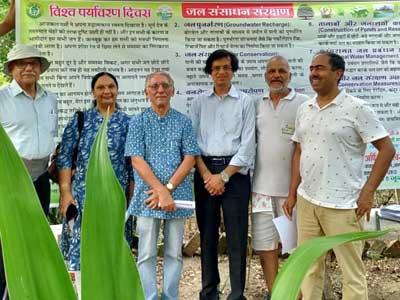
Agra: On World Environment Day, green activists took a stand for a more pedestrian and cyclist-friendly Agra, urging municipal and transport authorities to implement necessary measures. In a memorandum addressed to Agra’s municipal commissioner and district officials, they highlighted the lack of pavements and the encroachment of service lanes, making mobility both cumbersome and unsafe.
"The vinashkari vikas was responsible for reducing Agra to a civilisational sink," said Dr Mukul Pandya, a campaigner for greenery and biodiversity in Agra.
The activists emphasized the struggles faced by the city’s residents and its many foreign tourists. “A large number of foreign tourists who are used to walking long distances do not find Agra roads safe for walking,” shared a young Australian tourist, who also pointed out the nuisance caused by stray animals alongside rampaging vehicles.
A focal point of their appeal was the Yamuna Kinara road, a picturesque stretch running from the Taj Mahal to Water Works. They proposed clearing the existing pavement of encroachments and repairing it where necessary to create a safe walking space. “This would allow tourists to enjoy the grand Mughal monuments while walking in the evening or morning,” the activists noted. This scenic route offers stunning views of the Yamuna River and several Mughal landmarks, including the Taj Mahal and Agra Fort.
The activists also brought attention to the controversial Taj Corridor, now a lush green space between the Taj Mahal and Agra Fort, which became a focal point in the political fallout of 2003, the ouster of the then Mayawati government.
The memorandum underscored the exponential human and motor vehicle population growth over the past 25 years, significantly compromising pedestrian and cyclist safety in Agra. Residents and visitors alike are not only threatened by traffic but also face daily challenges from simians, canines, and bovines that roam freely.
Senior citizens have repeatedly raised concerns on social media about the acute shortage of parking spaces, rampant road encroachments, and pollution from heavy vehicle emissions. Each year, hundreds of pedestrians and cyclists fall victim to speeding vehicles. "Even at zebra crossings, one cannot cross without fear of being hit by a wayward vehicle," said Rajiv Gupta of Vijay Nagar colony, who has stopped going for his daily walks due to these hazards.
Criticizing current urban planning, the activists pointed out that roads are designed for vehicles rather than people, and traffic plans often take precedence over mobility plans, resulting in widespread chaos. The city is further crippled by the construction of the Metro line and ongoing repairs of two major rail overbridges, while the permanent bottleneck at Sikandra on the Delhi national highway adds to the daily inconvenience for commuters.
Agra, home to the iconic Taj Mahal and numerous historical monuments attracting millions of visitors annually struggles to cope with its burgeoning human and automobile population. The problem is exacerbated by marauding monkeys, stray dogs, and cattle roaming the streets.
Compounding these issues is the lack of coordination among the half-dozen departments responsible for the city's infrastructure, including the Taj Trapezium Zone Authority, the Agra Development Authority, the Agra Municipal Corporation, the district board, local police, and a vast bureaucracy. This disarray has left Agra without a comprehensive long-term mobility plan.
Vehicles are registered without verifying whether owners have adequate parking, resulting in cars parked along roadsides, further restricting mobility. Agra’s population now exceeds five million, with over two million registered vehicles and thousands more from other states traversing the city via two Expressways and several national highways. The opening of the Yamuna Expressway and the Agra-Lucknow Expressway has only increased the pressure on Agra's roads, creating an alarming situation.
The surge in private vehicle ownership has precipitated the collapse of Agra’s traffic management system. Long traffic jams, frustrated commuters, frequent street fights, and numerous accidents mark daily life in the Taj City.
Local citizens' forums and voluntary organizations advocate for prioritizing pedestrian and cyclist rights. They call for a shift from traffic management to mobility management, focusing on human needs rather than vehicles and accommodation. By implementing these changes, green activists hope to transform Agra into a safer, more enjoyable environment for both residents and tourists, preserving its historical charm while addressing modern challenges.
Meanwhile, concerned citizens have drawn the attention of the state government to a key project of former Uttar Pradesh Chief Minister Akhilesh Yadav, the Rs.133 crore 207 km-long cycle track from Etawah to Agra, which lies in a state of shambles for want of care and patronage. Many villagers use the track to dry cow dung cakes or wash clothes. The concrete-layered cycle track along the wilderness and ravines of Yamuna did not find many users or cycle enthusiasts.
"In the Bah area, the track was not even fully complete but the then government was in a hurry to inaugurate the project on November 26, 2016. Akhilesh Yadav wanted to promote cycling in a big way. "He was often seen cycling for rallies through villages. The cycle is the election symbol of the Samajwadi Party.
Related Items
Agra’s Kavya becomes Judge at prestigious poetry competition
Awareness camp organized on World Leprosy Day
Nearly 1500 animals rescued across Agra in 2024