
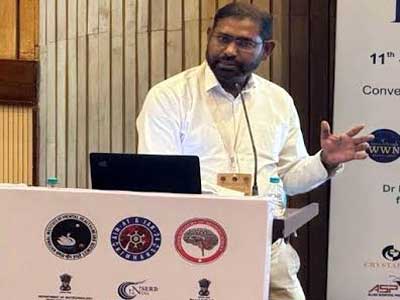
Aligarh: Dr Mehdi Hayat Shahi, a faculty member from the Interdisciplinary Brain Research Centre of Aligarh Muslim University, recently demonstrated how cadmium exposure could trigger tumorigenesis in in-vivo rat models, leading to cognitive deficits.
The study underlined the impact of cadmium toxicity on the brain and its role in activating tumour-associated pathways.
Dr Shahi delivered a talk in this context at the International Conference on Advances in Mechanisms and Approaches to Neuro-Therapeutics and the XLII Annual Meeting of the Indian Academy of Neurosciences.
The event occurred from November 12-14, at the National Institute of Mental Health and Neurosciences in Bengaluru.
Dr Shahi’s presentation, titled ‘Heavy Metal Cadmium May Induce Potential Brain Tumor Development by Up-regulating Mitogenic Shh-Gli1 Cell Signaling Pathway and Stem Cell Marker BMI1’, highlighted his recent research findings.
With nearly 20 years of research expertise in cell signalling and brain tumour biology, Dr Shahi has contributed significantly to the field with over 35 peer-reviewed publications and a book, ‘Role of Cell Signaling Pathways in Brain Tumorigenesis’, published by Springer Nature.
The IAN-24 conference attracted over 650 delegates worldwide, underscoring its prominence in the neuroscience community.
Related Items
AMU Research Scholars shine at Indian Philosophical Congress
Professor awarded for research in protein biochemistry
Professor awarded for research in medical sciences