
Mathura/Agra: For an elephant rescued after years of abuse, freedom is only the beginning. The real challenge starts after the chains are removed; healing damaged feet, rebuilding trust and learning how to live without fear. Wildlife SOS is now bringing international expertise to that difficult journey.
Wildlife SOS has strengthened its collaboration with McClure International Consulting to improve lifelong care for rescued elephants at its Elephant Conservation and Care Centre in Mathura.
The partnership combines Wildlife SOS’s nearly two decades of experience in elephant rescue with the international expertise of elephant-care specialist Mike McClure.
India is home to more than 60 per cent of the world’s remaining Asian elephants. The species is classified as Endangered on the IUCN Red List.
The latest DNA-based Synchronous All India Elephant Estimation estimates India’s wild elephant population at around 22,446. Habitat loss, shrinking forests and increasing human-elephant conflict continue to threaten their survival. But the elephants already rescued from exploitation face another battle: learning to live again.
Wildlife SOS established the ECCC in 2010 in partnership with the Uttar Pradesh Forest Department. It was India’s first specialised centre for rehabilitating severely abused elephants.
In 2018, the organisation opened India’s first dedicated elephant hospital on the adjoining campus. Today, the two facilities care for more than 30 rescued elephants.
Many arrived with badly damaged feet, mobility problems and deep psychological trauma. Some had spent years walking on concrete and other hard surfaces. Others had been forced to carry heavy loads, beg on roads or perform for entertainment.
At Mathura, the philosophy is simple: no chains, no exploitation and no shortcuts to recovery. The elephants have access to open spaces, water, nutritious food and veterinary care around the clock.
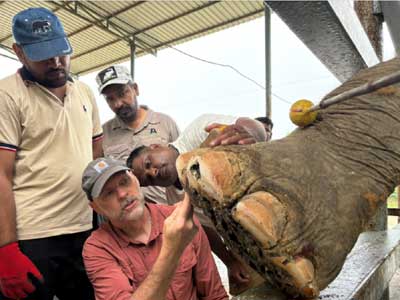
The latest week-long training programme brought MIC specialists to Mathura. They worked directly with Wildlife SOS veterinarians, elephant caregivers and other staff. The focus was firmly practical.
Teams worked on advanced foot care, mobility, positive reinforcement, socialisation and enrichment. Caregivers also learnt techniques to encourage natural behaviour and reduce stress during medical procedures.
Positive reinforcement is particularly important. Instead of forcing an elephant to cooperate, caregivers reward calm and cooperative behaviour. For an animal that has spent years being controlled by humans, such small changes can make a huge difference.
The programme also explored ways to improve relationships within the elephant herd. Social interaction, mental stimulation and a sense of security are considered important parts of long-term rehabilitation.
“Rescue is only the beginning of an elephant’s journey towards recovery,” said Kartick Satyanarayan, co-founder and CEO of Wildlife SOS. “Our responsibility is to ensure that every rescued elephant receives the best possible care throughout its life,” he said. International collaborations, he added, help the organisation learn, improve its methods and find new solutions to complex welfare challenges.
Venkata Sreekar Patel, IFS, Divisional Forest Officer, Mathura, welcomed the cooperation between Wildlife SOS and the Uttar Pradesh Forest Department.
“Such initiatives provide valuable opportunities for sharing knowledge and strengthening the capacity of teams working towards elephant welfare,” he said.
Wildlife SOS co-founder and secretary Geeta Seshamani stressed that no two rescued elephants have the same story.
“Every rescued elephant has a unique history,” she said. “Their recovery requires patience, expertise and a willingness to continually evolve our approach.”
Mike McClure described the collaboration as a two-way exchange. “Wildlife SOS has built an exceptional team with extensive experience in some of the most challenging elephant rescue cases,” he said. “Together we can continue finding new ways to improve elephant welfare.”
Baiju Raj MV, director of conservation projects at Wildlife SOS, said exposure to international practices would help the Mathura team keep improving.
“Exposure to global best practices in enrichment, elephant social behaviour and caregiving enables our teams to learn, share and evolve,” he said.
The message behind the partnership is increasingly important in wildlife conservation: rescue is not rehabilitation.
Taking an elephant out of suffering is just the first chapter. The harder work is helping it recover physically and emotionally and giving it a life worth living.
At Mathura, that work continues every day, one healed foot, one trusting gesture and one peaceful day at a time.
Related Items
Workshop held on ‘Advances in Deep Learning’
Early detection systems installed to reduce Human-wildlife conflict
Triathlon athlete Mitch Hutchcraft supports elephant care efforts