
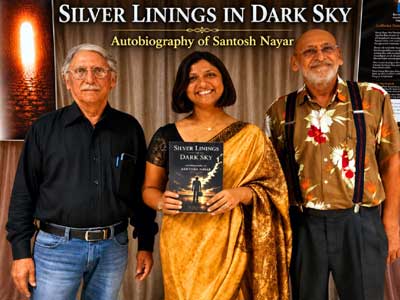
Mysuru: The autobiography of the late Santosh (Sam) Nayar, Silver Linings in the Dark Sky, was released at Hotel Royal Inn. Friends, admirers, writers, former colleagues and social activists gathered to launch the 278-page book.
Edited by Dr Alok Gupta and published by Pink Lotus, Varanasi, the book carries a clear message of purpose. Dr Gupta announced that all proceeds from sales will go to the PM CARES Fund. Among those present were an income tax commissioner, writers, chartered accountants and close associates of Nayar.
Also Read: When American Dream went wrong, India found the story...
Senior journalist Brij Khandelwal said the book is more than a tribute to Nayar’s writing talent. “It asks us to understand mental health, especially bipolar disorder, and to show sensitivity towards people who live with it,” he noted. Mukta Gupta described Nayar’s writing as honest and fearless, saying the book reveals both the bright and dark sides of his life in a way that touches readers deeply.
Dr Alok Gupta stressed that Nayar was never only a patient. “He was a professional, a traveller, a writer, a friend and a sensitive human being. His story reminds us that behind every illness is a full person who needs understanding, treatment and respect,” Gupta said. Jagan Benjamin added that the autobiography moves beyond one man’s struggle to deliver a wider message: society must break the silence and stigma around mental illness.
Also Read: अमेरिका में सपने टूटे, भारत में मिली कहानी…
Santosh Nayar, a chartered accountant who worked and lived in several countries, died on 4 May 2024. His manuscript survived him. Nearly a decade after it was preserved, it has now appeared as a book. In its pages, he writes with striking honesty about ambition, loneliness, relationships, mistakes, pain and hope. He also describes the complexities of bipolar disorder in deeply human terms.
Read in Hindi: दिवंगत संतोष नायर की आत्मकथा का हुआ विमोचन
What happens when the mind becomes both a battlefield and a prison? For Nayar, the answer was complicated. He experienced extraordinary highs and crushing lows while living with bipolar disorder. The book looks beyond the diagnosis to the man trying to understand himself.
Bipolar disorder is often casually called ‘mood swings’. That phrase makes a serious illness sound ordinary. It is not. People with bipolar disorder face distinct episodes of mania or hypomania and deep depression. During mania, sleep may feel unnecessary, thoughts race, confidence soars, and risky decisions can seem completely rational. Money can vanish, and relationships can break. In severe cases, delusions may appear. Depression brings the opposite: energy disappears, pleasure fades, and even simple tasks feel impossible. The cruel part is that during mania, a person may not feel ill at all.
Families often see behaviour before they recognise illness. Mania can look like arrogance, depression like laziness, and poor judgement like irresponsibility. Understanding the illness does not mean excusing every action. It means recognising that behaviour can have a medical explanation.
Public figures have spoken about the condition. Rapper Yo Yo Honey Singh has described bipolar disorder with psychotic symptoms and long periods when he struggled to function. Actress Shama Sikander has talked about bipolar disorder and depression that began quietly with disturbed sleep and withdrawal. The death of actor Sushant Singh Rajput brought the subject into many Indian homes and sparked discussion about psychiatric care.
India still has a large treatment gap. The National Mental Health Survey (2015–16) found a lifetime prevalence of bipolar affective disorder of about 0.5 per cent. That still means millions of people. Roughly 70 per cent of those currently affected receive no treatment. Stigma makes the journey harder. Words like ‘mad’ or ‘pagal’ close doors between suffering and help.
Yet bipolar disorder is treatable. Mood-stabilising medicines, psychotherapy, regular psychiatric care, adequate sleep, avoidance of substance misuse and family support can make a profound difference. Recovery may not remove every difficult day, but it can restore control, relationships and ordinary life.
Nayar’s story carries that hopeful truth. A diagnosis should explain a condition. It should never become a person’s entire identity. He was a professional, traveller, writer and friend who made mistakes and endured consequences while living with an unpredictable mind. His manuscript survived because he left more than a medical history. He left a testimony.
The book is available on Amazon. It is not only an autobiography. It is a document of courage, vulnerability and the search for hope even when the sky turns dark.
Related Items
Activists demand City Forest development to combat pollution
'Role of writers, not just as mirrors but as guides to society'
Activists demand tourist tax to fund pollution control measures