
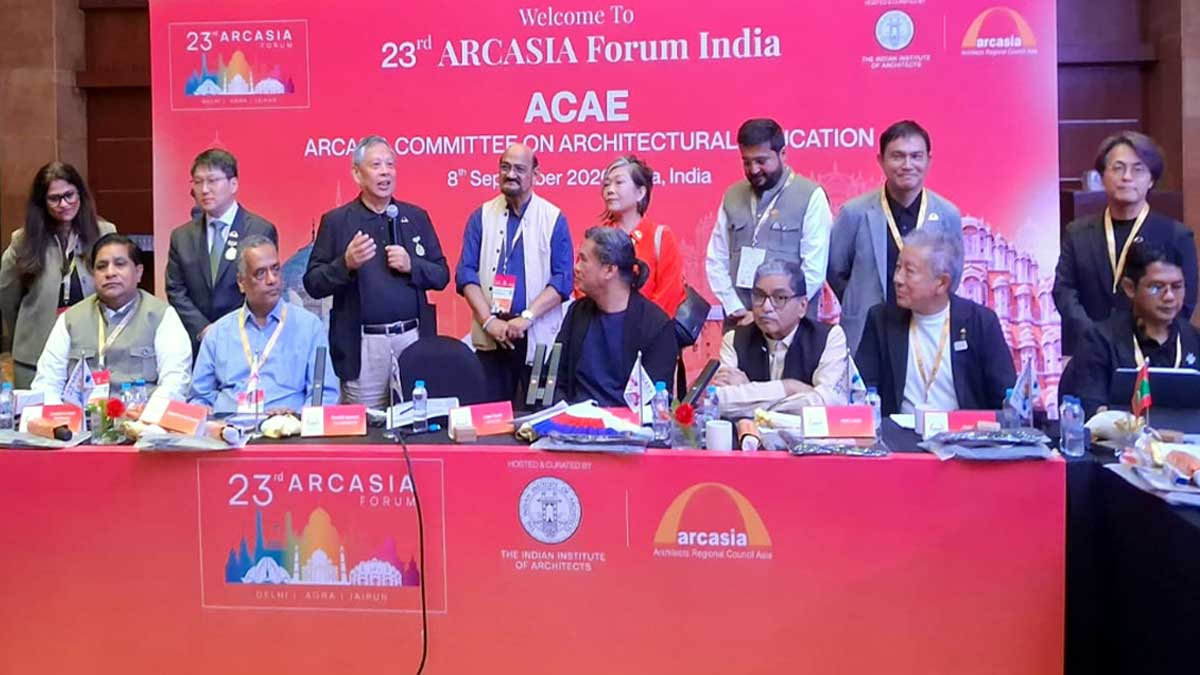
Agra: More than 600 architects, academicians, students and experts from 24 Asian countries gathered at Hotel Jaypee Palace for the five-day international forum, ARCASIA, organised under the aegis of the Indian Institute of Architects. The theme was ‘Bringing Back Vernacular Wisdom’.
The forum held across the Golden Triangle of Agra, Jaipur and Delhi, with Agra hosting ARCASIA committee and council meetings. More than 2,500 architects from India and abroad participated in the Open Forum in Jaipur on September 11 and 12.
Architect Tushar Sogani of Jaipur, convener of the forum, said Agra provided an ideal setting to showcase India's architectural heritage to the world. “India's vernacular wisdom has enormous strength. It is sustainable and rooted in local knowledge,” he said.
He stressed the need to bring India's archaeological knowledge, traditional materials and historical architectural techniques into modern construction. “The world needs to understand that our traditional architecture can offer solutions to many contemporary problems,” he said.
ARCASIA President Boo Jiang of China said modern technology had advanced rapidly, but traditional wisdom remained equally important. “Science has progressed and new technologies have emerged. Yet we have much to learn from our heritage,” he said.
The forum, he added, provides Asian architects with an opportunity for technical and intellectual cooperation and a chance to learn from India's architectural legacy.
IIA National President Vilas Vasant Avachat said foreign architects were mesmerised by the Taj Mahal during their visit on the first day. The Taj, he suggested, is not merely a monument to admire. It is also a lesson in design, materials, proportion, craftsmanship and climate sensitivity.
Avachat said the forum could help demonstrate how India's ancient architectural heritage could be adapted to contemporary needs without destroying its essential character. The IIA, he said, has around 35,000 architects as members and serves as a platform for professional and educational cooperation.
The city has three UNESCO World Heritage Sites, Taj Mahal, Agra Fort and Fatehpur Sikri, each offering lessons in durability and climate-responsive design. “Today's buildings can become sick within two or three years. They start leaking. But our 400- or 500-year-old heritage buildings often show not even a trace of dampness,” Gupta said.
The question, therefore, is simple that what did our ancestors know that modern construction has forgotten? Traditional buildings used local materials, natural ventilation, courtyards, shading, thick walls and climate-sensitive designs. Modern architecture, critics argue, has often replaced such wisdom with glass, concrete and mechanical cooling.
The opening day saw simultaneous online and offline meetings in five halls at Jaypee Palace. Discussions covered young architects, sustainable architecture, architectural education, social responsibility and professional practice. IIA-UP Chapter Chairman Sandeep Saraswat of Lucknow was also present.
The larger debate focused on climate-responsive architecture, natural building materials, traditional crafts, construction techniques, vernacular forms, cultural identity and urban design.
Related Items
InBidz Global Art Contest unites artists and trees
Visually challenged students visited ‘Numayish’
Professor gets 'Best Indian Golden Personalities Award'